
Pain on the Outside of Your Foot When Running? What's Causing It and How to Recover
The quick answer:
Pain on the outer (lateral) edge of your foot is usually one of three things:
A fifth metatarsal bone stress injury
Peroneal tendinopathy
Cuboid-related pain (or “cuboid syndrome”)
These range from a cranky tendon that may respond well to some load to a stress fracture, which can be dangerous to continue loading. So where it hurts and how it behaves matter before you lace up for another run.
If you're reading this mid-training block with a race on the calendar, we get it. Few things test your patience like a niggle that shows up right when your training is really showing up as fitness gains.
Here's how to sort out what's happening, what needs attention now, and how to get back to the roads, trails and track with confidence.
Why the foot is worth understanding
Your foot has 26 bones, 33 joints and over 100 muscles, tendons and ligaments, all working together to absorb and redirect several times your body weight with every footstrike. At The Runner's Academy, we love this stuff. The more you understand how those structures share the load, the easier it is to see how things go sideways.
A note before we dive in: this article covers general patterns and common presentations. It isn't a substitute for seeing a qualified healthcare professional, but it should help you make sense of what you're feeling.
The big three at a glance
This doesn't cover every possibility, but it captures the most common culprits and the clues that help us pinpoint the tissue at fault, so we can build an effective plan to get you back to your goals.
| Condition | Where it hurts | What it feels like | How it behaves on a run |
|---|---|---|---|
| 5th metatarsal bone stress injury | Outer midfoot, along the bone leading to the little toe | Sharp, pinpoint, tender directly on the bone | Worsens as the run goes on; often painful with everyday walking |
| Peroneal tendinopathy | Behind and below the outer ankle bone, along the outer foot | Dull ache and stiffness; pain pushing the foot outward against resistance | Often eases as you warm up, then aches after the run or the next morning |
| Cuboid-related pain (often called cuboid syndrome) | Outer midfoot, just in front of the heel bone | Deep ache in the outer arch; a "pebble in the shoe" feeling | Sharper at push-off and on uneven ground |
Step 1: Rule out a bone stress injury first
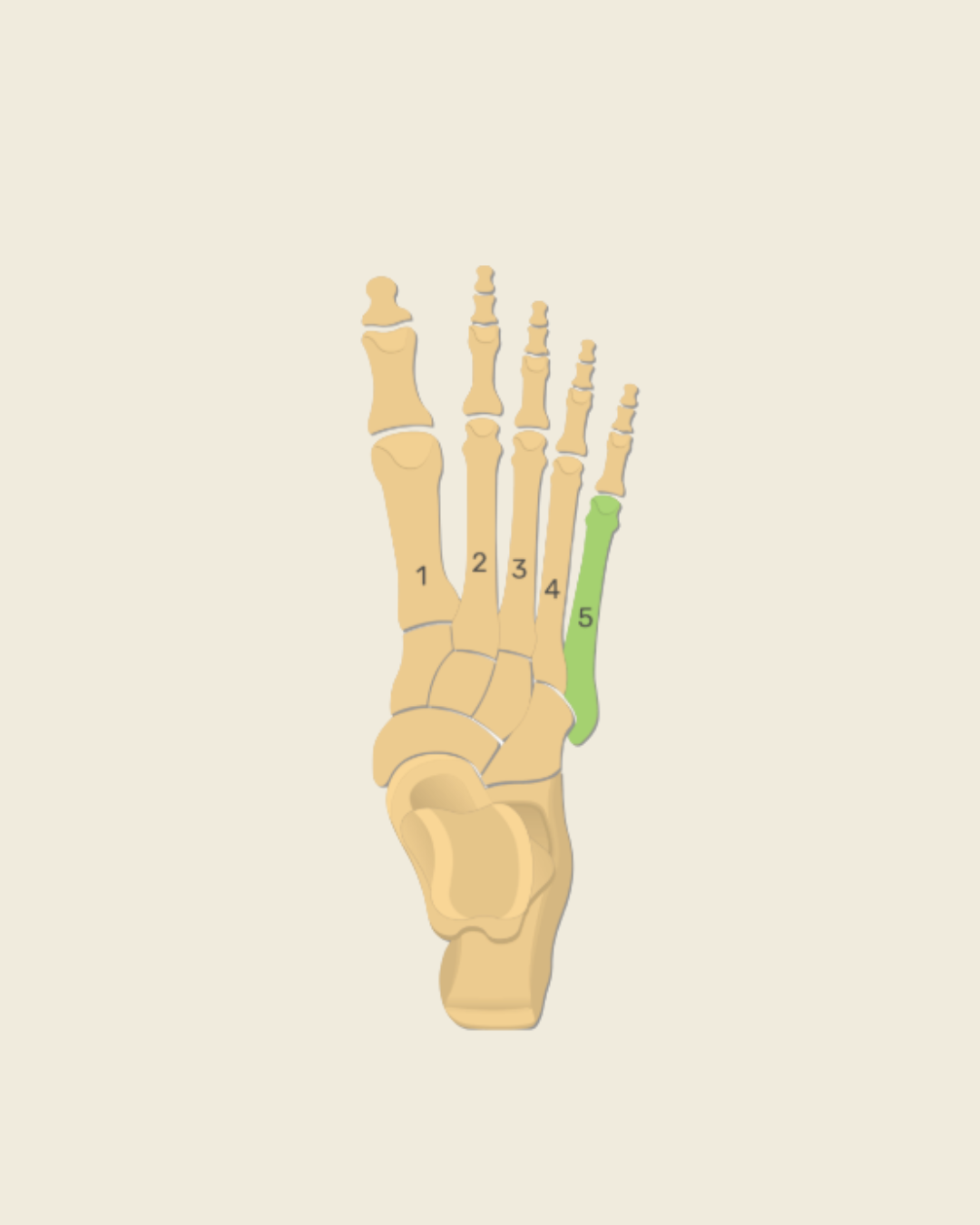
Bone comes first because it's the one you don't want to run through.
The fifth metatarsal is the long bone on the outside of your foot leading to your little toe. The bump you can feel on the outer midfoot is its base, a common spot for bone stress injuries.
Bone stress injuries exist on a continuum, from an early stress reaction within the bone to a fully developed stress fracture.
They often start as gradual, focused lateral foot pain.
Red flags for bone stress:
You can pinpoint the pain with one fingertip.
Pressing on the bone reproduces it.
Hopping on that leg, or rising onto your toes, hurts.
Walking is painful or makes you limp.
Pain worsens progressively during a run.
There's swelling or bruising.
Pain shows up at rest or wakes you at night.
Your training recently jumped in mileage, intensity or hills. We commonly see this injury 3-6 weeks after a spike in load.
*Again, none of these symptoms alone can confidently rule a stress injury in or out, but should be considered amongst a broader history.
After an acute injury: If you rolled your ankle or took a hard hit and now have tenderness at the base of the fifth metatarsal, or you can't take four steps, get assessed promptly. Clinicians use the Ottawa Foot Rules to decide whether an X-ray is warranted. Early bone stress reactions can look normal on X-ray, and MRI remains the gold standard, though timing can be challenging.
Dr. Kris Sheppard, a Toronto-based chiropractor with a practice dedicated to running injuries explains how to identify some of the key causes of foot pain in runners.
"But it warms up. Doesn't that rule out a stress fracture?"
It's a great question, and we hear it a lot.
Pain that fades a few minutes into a run tends to point toward muscle or tendon, while bone pain is more likely to stay steady or build with continued loading.
But that's a pattern, not a rule. Pain that eases as you run doesn't fully exclude a bone stress injury, so weigh it alongside tenderness, training history and exam findings.
Step 2: Peroneal tendons vs. the cuboid
If the pain is more diffuse than a one-finger spot, we turn to soft tissue and joint mechanics.
Peroneal tendinopathy
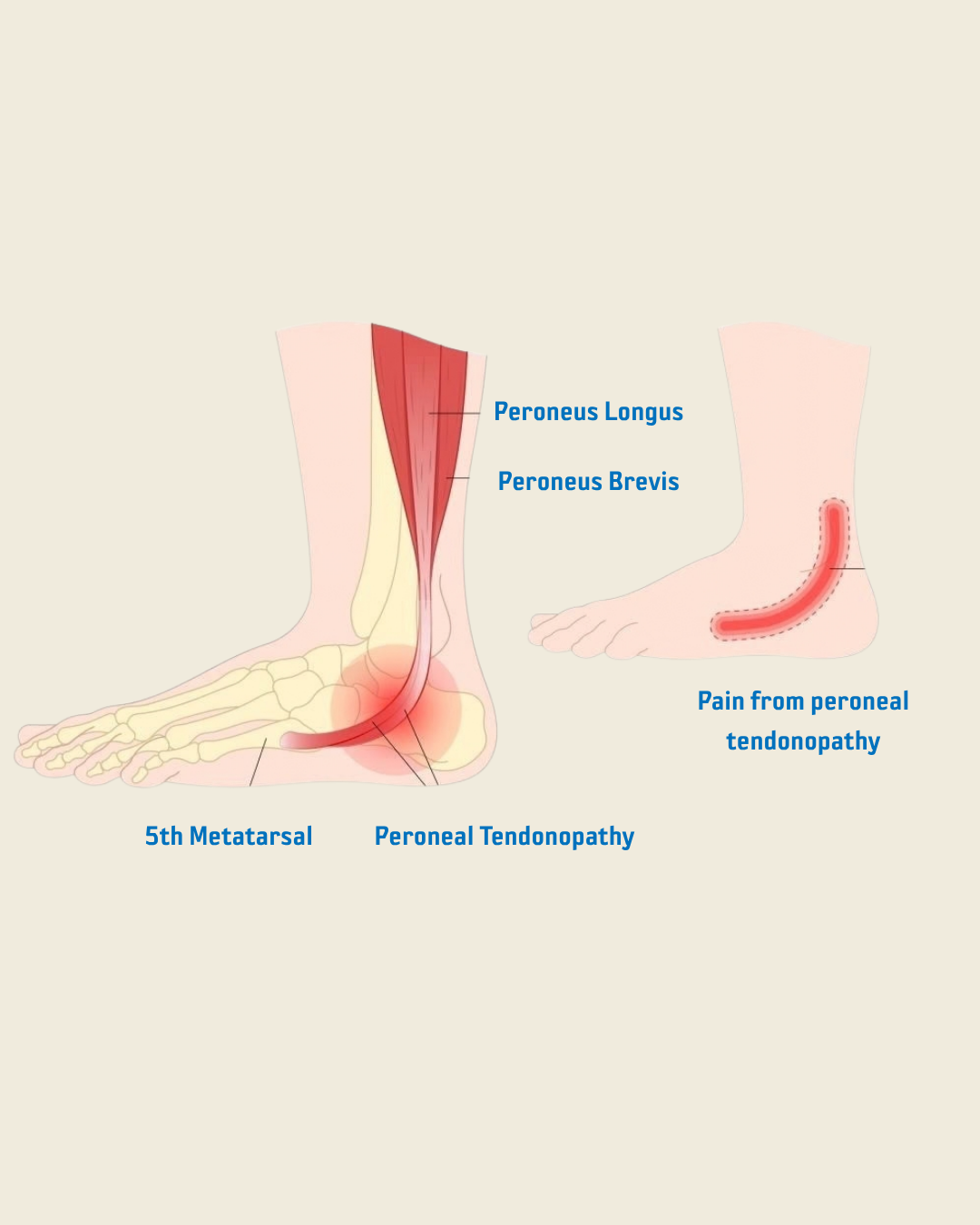
The peroneus brevis (attaching at the base of the fifth metatarsal) and peroneus longus (wrapping under the foot near the cuboid) are your key lateral stabilizers.
They work overtime on cambered roads and technical trails, and when the foot is under-supported, whether from footwear, strength and mobility gaps, a history of ankle sprains, or plain fatigue in a big training block.
What it tends to feel like:
Stiff for the first mile, easing as you warm up, then returning after the run or the next morning.
Pain along the outside of the ankle or foot
Pain where the brevis attaches can mimic bone pain, which is one more reason assessment matters.
Pain, weakness or a side-to-side difference when pushing the outside of the foot into resistance (eversion).
Early rehab options (progress by symptoms, and only after bone involvement has been reasonably excluded):
Isometric eversion against a wall or band
Progressive resisted eversion
Calf raises
Single-leg balance
Gradual return to running-specific loading
Cuboid-related pain (often called cuboid syndrome)
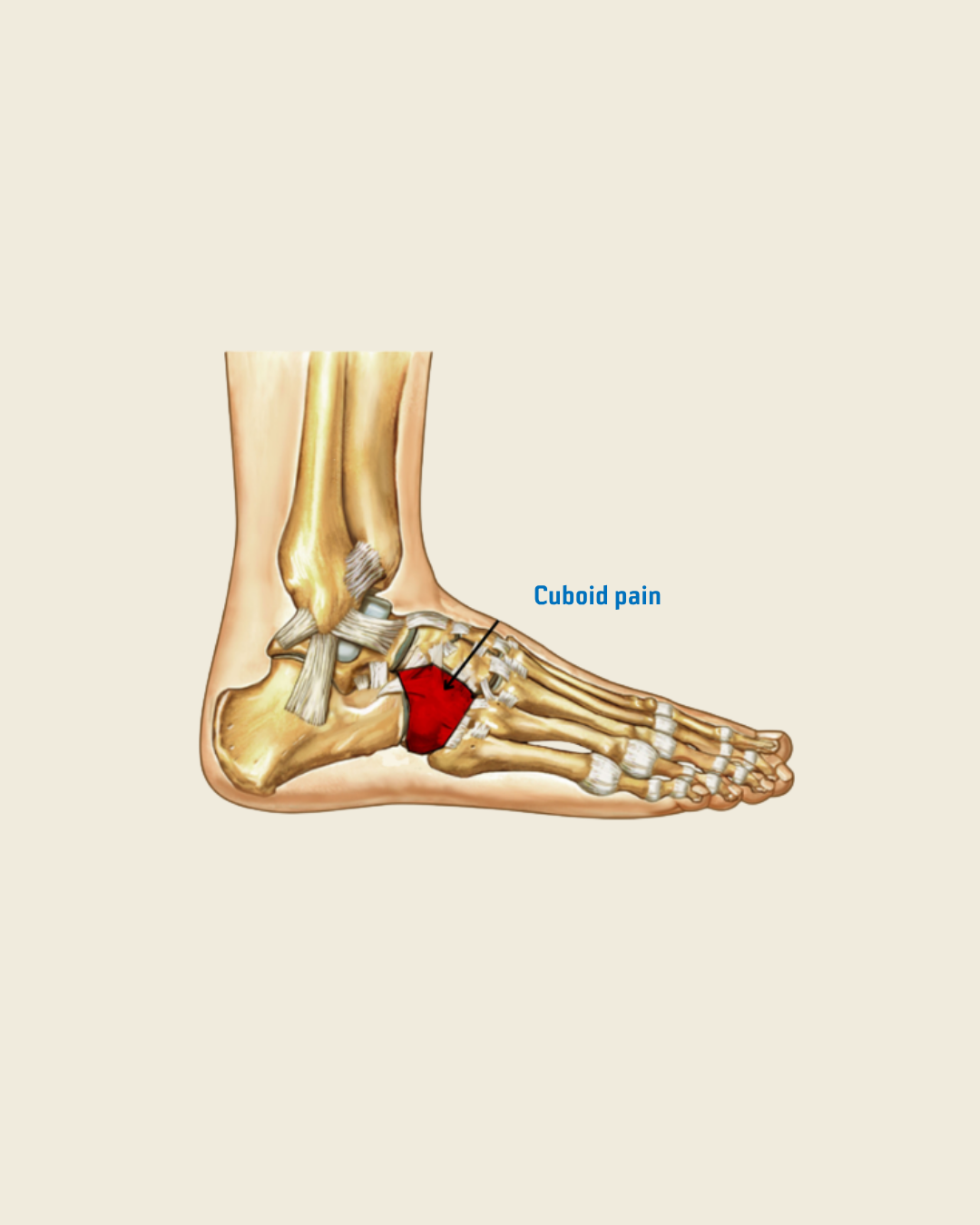
The cuboid is a small bone in the outer midfoot, just in front of the heel bone. It helps form the lateral arch and guides the peroneus longus tendon.
Pain here is usually felt through the middle of the outer foot rather than right over the fifth metatarsal. It can follow an ankle sprain or repeated loading of the outer foot, and it can be quite limiting when walking.
A note on "syndromes": "cuboid syndrome" is a widely used label, but there's no single definitive diagnostic test, and the research behind specific exam techniques is limited. Its symptoms can mimic an ankle sprain, a tendon problem, or a fifth metatarsal stress injury, so those should be considered as well.
Step 3: Look beyond the foot
Once a bone or traumatic injury has been reasonably excluded, the useful question becomes why the outside of the foot is taking more load than it can currently handle.
The foot moves between two broad strategies, both of which happen in 3D:
Pronation helps the foot adapt and absorb load. It happens anytime the arch of the foot is lowering.
Supination helps it become a rigid lever for push-off. It happens anytime the arch is lifting.
Pronation is a normal and necessary part of the gait cycle. It isn’t the villain, and there's no single "perfect" foot position. The trouble starts when you stay loaded along the outside edge and struggle to roll toward the big toe.
Here are three quick self-checks.
None of them is diagnostic. They're a way to get curious about how you move.
1. Single-leg standing check. Stand barefoot on the affected leg. Is your weight fairly equally spread through the heel, the base of the big toe and the base of the little toe, or does it stay on the outer edge? If it's more to the outside, that may mean you spend more time loading that tissue. Teaching yourself to use the rest of the foot more may offload the lateral aspect enough to meaningfully change your experience on the run.
2. Lower-leg rotation. Sit with your foot flat and imagine a line down the centre of your kneecap. Gently rotate the knee in and out while keeping the whole foot on the ground. Does the leg rotate smoothly, and does the foot respond or stay rigid? Restriction doesn't automatically mean something is wrong, but it's worth noting alongside lateral loading, ankle weakness or running symptoms. As you accept load with each step, getting rotation through the lower leg is a key part of moving well through the foot and ankle. If you can't get good rotation here, it could be part of what drives more load to your painful tissue.
3. The big toe. Can you extend the big toe comfortably while the ball of the foot stays down? Then do a slow calf raise. Can you keep pressure through the base of the big toe instead of rolling to the outside? If the answer is no to either question, learning to use the muscles controlling that toe better could make a big difference.
Building foot capacity
Research suggests that strengthening the small muscles of the foot can improve foot strength, balance and some aspects of foot function (Taddei et al., 2020). While no single exercise fixes every running injury, useful options include:
Big-toe extension and control work
Foot tripod drills (pressing evenly through the heel, big-toe base and little-toe base while keeping the arch gently lifted)
Calf raises with pressure held through the big toe
Floating heel exercises [add a one-line description or link]
Ankle eversion strengthening
Single-leg balance
Gradual pronation and weight-shift drills
The goal isn't to force the arch to collapse or to "overpronate" on purpose. It's to give your foot options, so it can absorb force, adapt, and then firm up again when it's time to push off.
Check out some great options to start building strength in the foot.
When to stop running
Pause and get assessed if the pain:
Is sharp and localized over a bone
Makes you limp
Gets worse as the run goes on
Shows up during normal walking
Comes with swelling or bruising
Persists at rest or wakes you at night
Began after a sudden twist, fall or impact
Running through a suspected bone stress injury can let it progress and significantly extend recovery. For milder, tendon-like symptoms, temporarily reducing volume, speed and hills is often reasonable. Cross-training can continue if it doesn't reproduce the pain.
Again, we may be biased, but we can't stress enough how valuable it is to have a clinician with experience managing running-related injuries in your corner. Depending on the tissue involved, the amount of load that is "safe" while you recover and get back to chasing your goals will vary.
Too often, we see athletes who respond to pain by cutting load, waiting for the pain to resolve, then returning to running and getting frustrated when symptoms come back quickly. Oftentimes in those cases, they haven't necessarily fixed the problem; they've just stopped loading it, and become weaker and less tolerant to load in the meantime.
That pattern applies mostly to tendon and other soft tissue problems. If bone stress is on the table, get assessed before you load it.
The bottom line
Outside foot pain is a location, not a diagnosis. Start by ruling out the fifth metatarsal and other bone involvement. Then look at the peroneal tendons, the cuboid region, ankle strength, lower-leg rotation, balance, and your ability to shift pressure toward the big toe.
Good rehab doesn't just treat the sore spot. It identifies which structure is irritated, works out why it became overloaded, and rebuilds your foot's capacity to handle the running you love. Setbacks are part of the sport, and a smart plan gets you back to it.
This article is for general education and doesn't replace individualized medical or physical therapy assessment.
We exist to help you reach your goals with confidence!
If you’re looking for running physiotherapy, chiropractic, or coaching services and are located in Toronto or Hamilton, we’d love to chat all things running with you.
Whether you’re overcoming an injury, keen to dial in performance or simply want to run joyfully for as long as possible, we’ve got you!
We specialize in the latest best practices for treating running injuries across our clinic locations in Hamilton, Downtown Toronto, and Midtown Toronto.
Book now in:
Next on your Reading List
Stress Fractures and Bone Stress Injuries: What You Need to Know
Returning to Running After Injury? Start Here
The Ultimate Guide to Preventing Running Injuries
References
Taddei, U. T., Matias, A. B., Ribeiro, F. I. A., et al. (2020). Effects of a foot strengthening program on foot muscle morphology and running mechanics: A proof-of-concept, single-blind randomized controlled trial. Physical Therapy in Sport, 42, 107-115. [verify]
Warden, S. J., Edwards, W. B., & Willy, R. W. (2021). Preventing Bone Stress Injuries in Runners with Optimal Workload. Current Osteoporosis Reports, 19(3), 298-307. https://doi.org/10.1007/s11914-021-00666-y